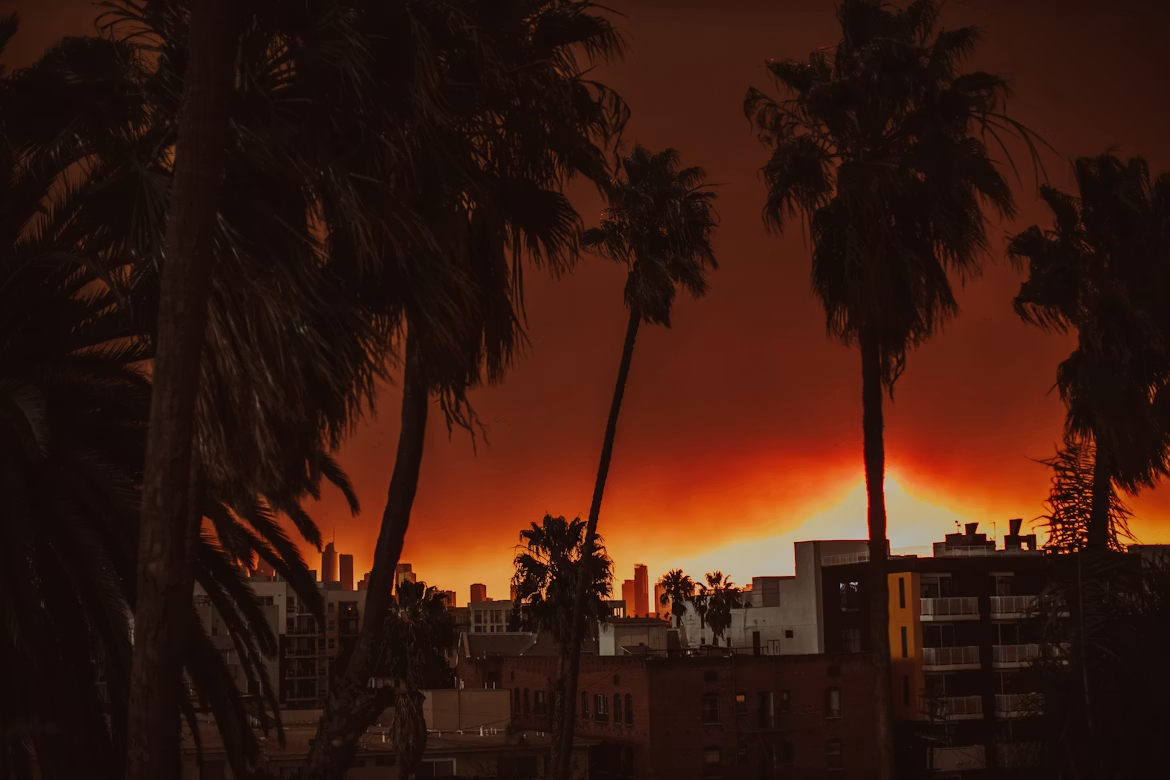
Eighteen months after the most destructive fire in Los Angeles history, a federal courtroom is asking who lit the spark. The harder question — how a charred landscape actually heals — is still playing out on the slopes above the Pacific Palisades.
Key Takeaways:
- The trial focuses on alleged ignition of the Palisades Fire, but the bigger issue is why the landscape became so vulnerable in the first place.
- Even after cleanup in areas like Pacific Palisades, the burned hillsides remain unstable and prone to erosion and debris flows.
- Emergency recovery (debris removal, utilities, stabilization) led by agencies like the U.S. Army Corps of Engineers is largely complete, but it only provides temporary protection.
- The core damage is ecological: fire removes soil biology and creates water-repellent (hydrophobic) ground, so rain runs off instead of soaking in.
- Without restoring the living soil layer first, replanting efforts struggle and slopes remain unstable.
- Long-term recovery depends on rebuilding soil function before vegetation—not just cleaning up or replanting.
In a downtown Los Angeles federal courtroom this week, prosecutors began laying out their case that a single small fire, set in the first dark hours of New Year’s Day 2025, smoldered underground for a week before hurricane-force Santa Ana winds dragged it back to the surface and turned it into the Palisades Fire — a blaze that killed 12 people and destroyed more than 6,800 structures.
The defendant, 30-year-old Jonathan Rinderknecht, a former Uber driver and onetime Palisades resident, has pleaded not guilty to three federal charges and denies starting the fire. Opening statements were heard June 10, and the trial is expected to run roughly two weeks. No verdict has been reached, and Rinderknecht is presumed innocent.
Outside the courtroom sits a quieter, slower, and arguably more important story: what is actually happening to the land?
What the trial is really about
Federal prosecutors allege that Rinderknecht maliciously ignited what became known as the Lachman Fire near the Palisades Highlands early on January 1, 2025. In their telling he had been driving passengers that night, and was the only person near the fire when it began.
The defense counters that there is no proof Rinderknecht lit anything, and that he is being made a scapegoat. His attorney has argued the real failure came afterward. The Lachman Fire burned fewer than 10 acres of open brush and destroyed no structures, and crews believed they had put it out. Instead, it kept burning underground in the root systems of dense vegetation, a so-called holdover fire. Then a historic windstorm on January 7 brought it roaring back.
The spark is on trial, but the conditions that let a spark become a disaster are a separate question entirely. Dry fuel, water-repellent soils, steep slopes primed to shed fire and, later, mud, along with years of poor water management, are among the conditions that built up the destruction of the Lachman fire
Where the Palisades stands now
A year and a half on, the recovery is real but uneven.
The cleanup phase is largely behind the community. The U.S. Army Corps of Engineers completed the bulk of structural debris removal across the burn area, following the EPA’s hazardous-materials sweep, and most lots have been cleared and certified. Gas, electric, water, and telecommunications service has been restored across most of Pacific Palisades, though some hillside and canyon properties remain pending. Rebuild permit applications have climbed steadily through early 2026, helped by streamlined and partially waived requirements for fire rebuilds. A $600-million effort to rebuild the area’s destroyed schools has moved ahead of its original timeline.
The slower story is the ground itself. More than half of the burned slopes around the Palisades burned at moderate or high severity, leaving soils prone to erosion, debris flows, and landslides, exactly the cascade that has haunted Southern California burn scars from Montecito onward. In the first winter after the fire, emergency crews scrambled to hold the hillsides together: conservation corps members installed more than 82,000 linear feet of straw wattles and placed thousands of sandbags, while a state-led watershed task force laid down more than a hundred miles of protective materials and cleared hundreds of thousands of cubic yards of debris from basins downstream.
That work prevented disaster during the wet months. But straw wattles and silt fences are triage. They buy time. They do not rebuild a landscape’s ability to absorb water and hold itself in place. That capacity lives in something far less visible than a sandbag line, the living crust of the soil surface itself.
The recovery that doesn’t make headlines
Here is the part the trial coverage will not touch.
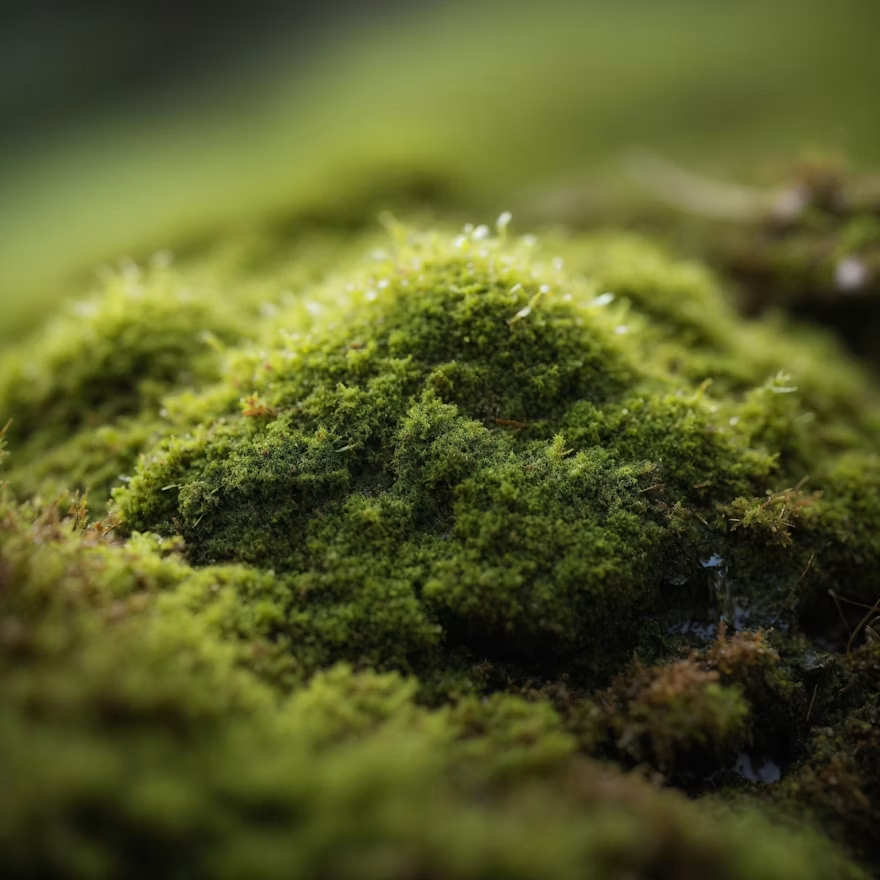
When fire strips a hillside down to bare mineral soil, it doesn’t just remove plants — it removes the biological skin underneath them, mosses, cyanobacteria, lichens, and the fungal threads that knit them together form what scientists call a biological soil crust, or biocrust. That crust is what lets rain soak in instead of sheeting off, what binds loose particles against wind and gravity, and what rebuilds the underground nutrient and moisture network that larger plants depend on to survive.
Strip it away, and water arrives on a hydrophobic, structureless surface and runs straight downhill, taking soil, ash, and whatever was planted on top of it along for the ride. This is why so much conventional post-fire revegetation underperforms: seeds and seedlings are dropped onto ground that can no longer hold them.
The most promising work in restoration ecology flips the usual sequence. Instead of planting trees and shrubs first, it rebuilds the soil surface first — re-establishing pioneer mosses that can colonize bare burned ground within weeks, restore infiltration, and slow erosion before the next storm. Only then do the larger plants go in, onto a surface that can actually keep them alive. The framing that guides this approach is deceptively simple: you cannot control the rain, but you can control how ready the land is to receive it.
For a burn scar like the Palisades; steep, drought-stressed, perched above neighborhoods that flood when the hills give way — readiness is everything. The emergency wattles held the line through one winter. The question now is whether the slower, living infrastructure underneath gets rebuilt before the protections wash out.
The verdict and the longer reckoning
A jury will soon decide whether Jonathan Rinderknecht is responsible for the spark. That verdict, whichever way it lands, will close one chapter of the Palisades story.
It will not, on its own, change anything about the hillsides. The soils will still be water-repellent. The slopes will still be bare in the places replanting hasn’t reached. The next red-flag wind and the next atmospheric river will still find a landscape that has not yet been made ready.
That work — unglamorous, uncovered, and measured in seasons rather than headlines — is the real verdict pending over the Palisades. And it’s one we get to decide every winter, on every slope, long after the courtroom empties.
This is part of an ongoing series on California wildfire recovery and the science of restoring fire-damaged landscapes.
Leave a Reply