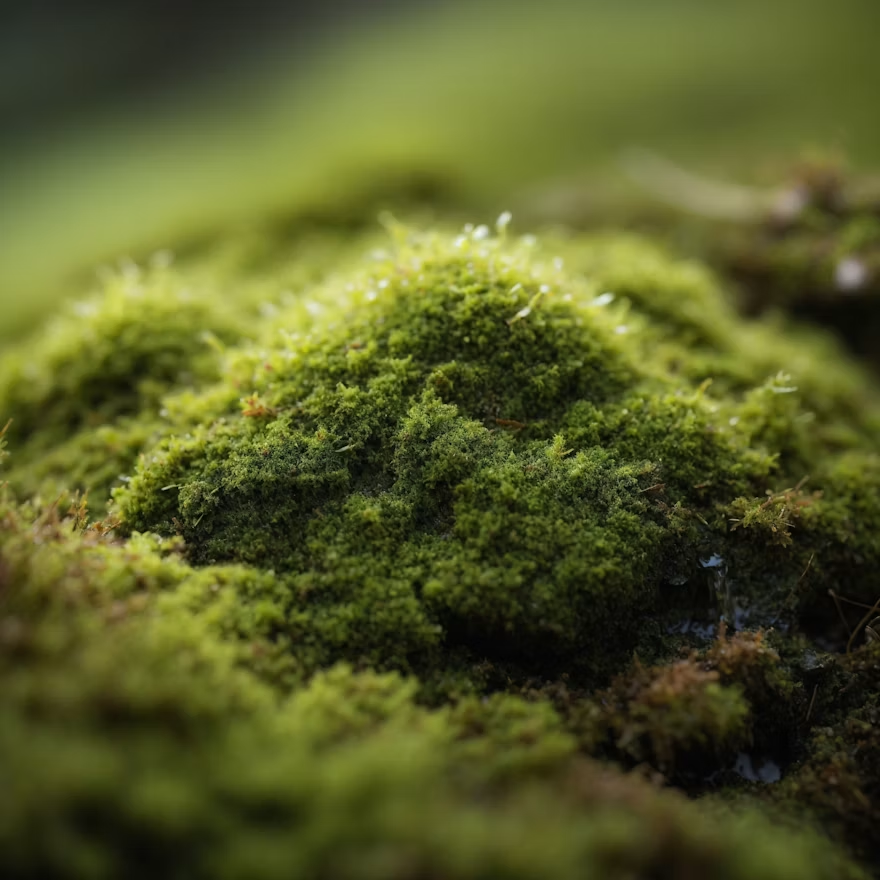
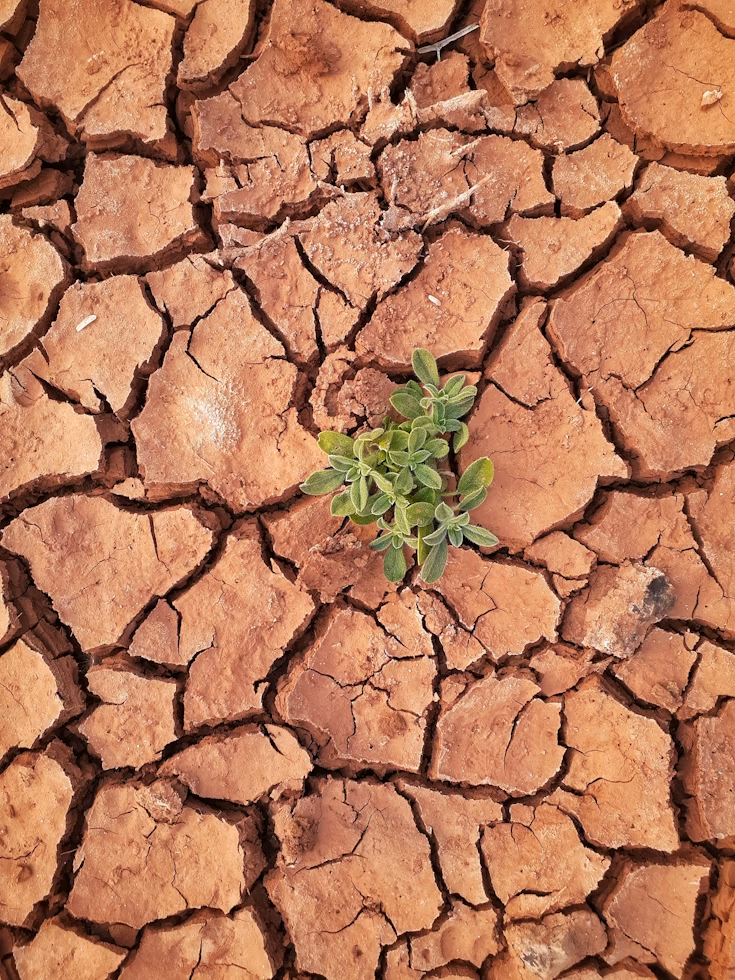
It looks like dirt. It’s actually one of the most important living communities on the planet — a thin, breathing layer that holds drylands together, pulls nitrogen out of thin air, and decides whether a landscape erodes or endures. Once you learn to see it, you can’t unsee it.
Key Takeaways
- Biocrusts are living ecosystems, not bare dirt. They are thin communities of mosses, cyanobacteria, lichens, fungi, algae, and microbes that form the Earth’s “living skin.”
- They are the foundation for plant life. They stabilize soil, improve water retention, naturally fertilize exosystems, thereby building the foundation for healthy landscapes
- Biocrusts are globally important. They cover roughly 12% of Earth’s land surface, particularly across drylands that make up more than 40% of the planet’s land area.
- They are highly vulnerable to disturbance. Foot traffic, vehicles, grazing, and fire can destroy biocrusts in moments, while natural recovery may take years or decades.
A knobby, textured, faintly green or blackish layer, sometimes spongy, sometimes crunchy. That is biological soil crust, and it’s alive.
Scientists at the U.S. Geological Survey, who study these communities for decades and refer to them as the“living skin” of the Earth’s drylands (USGS). It’s an apt metaphor. Like skin, a biocrust is thin, easily wounded, slow to heal — and absolutely essential to the health of everything beneath it.
What a biocrust actually is
A biocrust isn’t a single organism. It’s a partnership — an intimate community of tiny life living in and on the top few millimeters of soil. The members include:
- Cyanobacteria — ancient photosynthetic microbes whose sticky filaments thread through the soil and bind particles together.
- Mosses — the small, rootless plants that are often the most visible green component, and the ones we focus on most in restoration.
- Lichens — composite organisms (a fungus living with an alga or cyanobacterium) that armor the surface.
- Algae, fungi, and other microbes — the supporting cast that rounds out the food web.
The most-cited scientific definition, refined by USGS researchers, describes a biocrust as an intimate association between soil particles and a mix of photosynthetic and other organisms living within or just on top of the uppermost millimeters of soil — extremotolerant life that dries out routinely and yet binds the surface into a coherent living layer (USGS, What is a biocrust?).
That last part is the key. The organisms don’t just live on the soil — through their growth and their sticky secretions, they physically engineer the soil surface into a stable crust. The community and the ground become one thing.
What is the difference between biocrust and topsoil?
Biocust and topsoil share similar qualities, even roles. The easiest way to differentiate between them is their location. Biocrusts typically are associated with dryland or desert ecosystems where top soil is found much more broadly. We can also physically see the differences. Biocrust is a thin layer that sits on top of the ground, maybe a few millimeters thick. Topsoil in contrast can be a few inches to over a foot deep
| Biocrust | Topsoil |
| A living layer on the soil surface made of organisms like cyanobacteria, algae, lichens, mosses, fungi, and microbes | The uppermost layer of soil, consisting of minerals, organic matter, water, air, and many living organisms |
| Usually only a few millimeters to centimeters thick | Can range from a few inches to over a foot deep |
| Functions as a biological “skin” covering the soil | Functions as the main rooting zone for most plants |
| Common in drylands and deserts | Found in many ecosystems worldwide |
They’re not rare — they’re everywhere we’re not looking
It’s easy to assume something this overlooked must be obscure. The opposite is true. Biocrusts cover an estimated 12% of the Earth’s entire land surface (Rodriguez-Caballero et al., 2018, Nature Geoscience, as cited by USGS). They’re the dominant living ground cover across much of the world’s drylands, and drylands themselves make up more than 40% of the planet’s land and support roughly a third of all humanity.
In other words, the living skin of the Earth quietly blankets an area larger than many countries, in exactly the places where soil is hardest to hold and water is hardest to keep. We’ve just never been taught to see it.
What biocrusts do
For something so thin, a biocrust does a remarkable amount of work. Researchers have documented a whole suite of functions (Ferrenberg, Tucker & Reed, 2017, Frontiers in Ecology and the Environment). The big ones:
- It holds the ground together. This is the function biocrusts are most famous for. By binding loose particles, the crust resists erosion from both wind and water. When biocrusts are destroyed, those same soils become far more prone to blowing away as dust and washing away as mud (USGS). A living crust is the difference between a stable surface and a dust storm waiting to happen.
- It manages water. Biocrusts influence how rain interacts with soil, slowing runoff and, in many settings, helping water infiltrate. In a field experiment, moss-dominated biocrust substantially increased rainwater interception and infiltration while cutting erosion by up to roughly 94% versus bare soil (Wang et al., 2023, iScience).
- It makes its own fertilizer. Many biocrust organisms, especially cyanobacteria and certain lichens, pull nitrogen straight out of the atmosphere and convert it into forms that plants can use, a process called nitrogen fixation. Combined with dust-trapping and nutrient cycling, this means biocrusts actively build soil fertility in places where there’d otherwise be very little.
- It opens the door for everything else. Because biocrusts stabilize the surface, hold moisture, and enrich the soil, they make it dramatically easier for larger plants to establish. The crust often comes first; the shrubs and grasses follow. This is why, in restoration, rebuilding the crust is the foundation that makes later planting succeed.
Why moss is the part we focus on
A biocrust can be built from many organisms, but mosses are special for restoration work, for a few practical reasons.
First, they’re visible and fast. Pioneer mosses are among the quickest colonizers of bare, disturbed ground, which makes them ideal for getting a protective living surface established in a hurry, after a fire, after construction, after any disturbance that leaves soil exposed.
Second, they’re propagable. Unlike many biocrust components, mosses can be deliberately grown and spread. Every tiny fragment of moss tissue can regenerate into a whole new plant, which means a small amount of starter material can be multiplied into enough to treat a large area. (We cover exactly how to do this in How to Grow Moss with a Blender and Buttermilk.)
Third, the science backs them. Researchers have shown that moss biocrusts can be produced in greenhouses to rehabilitate degraded dryland soils (Antoninka et al., 2016, Restoration Ecology), that their establishment can be boosted with helper microbes (Tian et al., 2022, Frontiers in Microbiology), and that simple field aids like jute netting can multiply their cover several-fold (Slate et al., 2020, Restoration Ecology).
Bedamoss callout
The catch: they’re fragile, and slow to come back
The same thinness that lets a biocrust hug the soil surface makes it terribly vulnerable. A single footstep, a tire track, a grazing hoof, or a fire can destroy in a moment what took years or decades to build. And recovery is slow — biocrusts are exceptionally sensitive to disturbance, and increasingly to a warming, drying climate (USGS).
That fragility cuts both ways. It’s why so much dryland and post-fire ground stays bare and erosion-prone for so long after it’s disturbed. But it’s also why deliberate restoration matters so much: left alone, a damaged biocrust may take decades to return on its own, or may never return if invasive plants or repeated disturbance get there first. Helping it along, intentionally, can compress that timeline from decades to seasons.
Learn to see it
The next time you’re outside in a dry, open, or recovering landscape, look down at the spaces between the plants. That textured, living layer is doing more for the health of the place than almost anything you can see standing up. It’s holding the soil against the wind, deciding where the rain goes, quietly making nitrogen, and laying the groundwork for everything that grows there next.
It’s the living skin of the Earth. And like our own skin, we mostly notice it only when it’s wounded, which is exactly the moment it needs us most.
Leave a Reply